


Page last updated: November 23, 2018
All pages copyright © 2018 by Pinyon Publishing

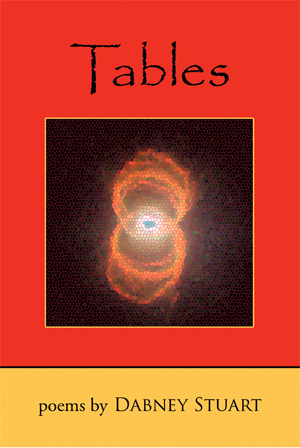
TABLES
Poems by Dabney Stuart
Dabney Stuart's new book of poems, Tables, moves from a focus on nuclear physics to astronomy. Stuart's use of these controls isn't technical, though some of their terms and concepts are explicit: e.g., "strong forces," "fission," "black holes," "dark matter." More pervasive, imbedded in the vision the poems embody, are images from these two areas. Stuart uses them in a variety of contexts to explore dimensions of everyday human experience.
In "Yucca Mountain," for instance, the place planned for the burial of nuclear waste becomes a focus for the yucca plant itself, the dances Native Americans once performed on the little mountain, and the speaker's memories of his father.
Family is one of the recurrent contexts for the understanding particle physics shadows. "Vowel Sounds" begins with the problem of naming newly discovered forces, and moves toward a conclusion in which discrete particles and the friction among them become an image of how families work.
Artists and other non-scientific characters─Cézanne, Miro, Ezekiel, Sidney, Klee─counterpoint these ruminations. Stuart's unpredictable humor colors these poems, as does his love of life and the complex ways we speak of it.
 DABNEY STUART has published fourteen previous volumes of poetry, most recently Long
Gone, Settlers, The Man Who Loves Cézanne, and Family Preserve. A former resident
at the Rockefeller Center in Bellagio, Italy, he has also held a Virginia Artists
Fellowship, two fellowships from the National Endowment for the Arts, and a Guggenheim
Fellowship. He won the Library of Virginia Poetry Prize for 2006. His work is in
the audio and video archives at the Library of Congress.
DABNEY STUART has published fourteen previous volumes of poetry, most recently Long
Gone, Settlers, The Man Who Loves Cézanne, and Family Preserve. A former resident
at the Rockefeller Center in Bellagio, Italy, he has also held a Virginia Artists
Fellowship, two fellowships from the National Endowment for the Arts, and a Guggenheim
Fellowship. He won the Library of Virginia Poetry Prize for 2006. His work is in
the audio and video archives at the Library of Congress.
Dabney Stuart and his wife Sandra live in Lexington, Virginia.

LISTEN

NEW MEXICO BOOK AWARD FINALIST
The New Mexico Book Awards honor great books from New Mexico and the Southwest. Tables explores New Mexico’s cultural, political, and natural history. Judged by a distinguished panel of scholars and librarians, Tables was named as a finalist for the best New Mexico poetry book.
READ A REVIEW
By Cy Dillon
in the Virginia Libraries Reviews
“These poems move across the reaches of the mind...49 poems cut and set so precisely that no mortar is necessary...”
READ AN EXCERPT
Talon
“From the ledge of my cell window last night
Pero the dreamhawk took two avocados...”
Only the One Sky (2016) A timeless world, dialogs with an old poet, whom we see as he muses in forests, along the river, or come through time (6"x9" paperback, 112 pages, ISBN: 978-1-936671-36-6, $16.00).
Times Body (2014) New and Selected Poems (1994-2014), (6"x9" paperback, 174 pages, ISBN: 978-1-936671-22-9, $18.00).
Greenbrier Forest (2012) Meditations deriving from the sights and sounds of Greenbrier Forest in West Virginia (6"x9" paperback, 80 pages, ISBN: 978-1-936671-03-8, $15.00).
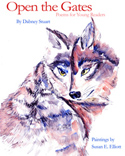
Open the Gates, Poems for Young Readers (2010): (8"x10" paperback, full color, 92 pages, ISBN: 978-0-9821561-6-2, $27.00).
Page last updated: November 23, 2018
All pages copyright © 2018 by Pinyon Publishing