

Page last updated: May 16, 2023
All pages copyright © 2023 by Pinyon Publishing


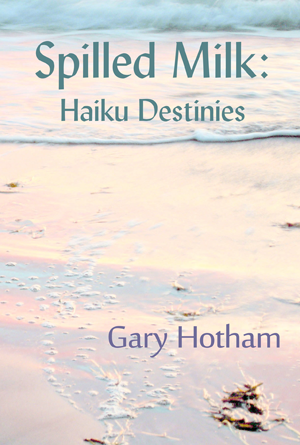
SPILLED MILK:
Haiku Destinies
By Gary Hotham
In these finely crafted poems, the work of a decade of noticing, observing, and writing, Gary Hotham asks us to see in the dark with our eyes wide open.
not here long—
a child asks to see
a star fall
A Word’s Worth Review, August 13, 2012 :
“The revelations contain universal messages and emphasize the gratifications we can experience by observing small occurrences in our daily lives – if we look and listen carefully, rather than engage in ‘talky business.’” Read the Review
* * *
Mildred Kanterman Memorial Merit 2011 Book Award, Summer 2012:
The Haiku Society of America sponsors this annual award for excellence in published haiku, translation, and criticism. Hotham’s Spilled Milk was one of three books to receive an Honorable Mention.
* * *
The Mainichi Daily News, June 19, 2011:
“Spilled milk— / nothing more / pours out” . . . The author continues casting a unique gazing over the spilled milk and finally obtains "suchness": No more milk pours. It's really a new finding nobody has ever pointed out.
* * *
Issa’s Untidy Hut: The Poetry Blog for Lilliput Review, Don Wentworth, April 23, 2011:
Some days I think the highest praise I can say about the work of a haiku poet is that her or his poems suggest the world. . . .
Gary Hotham's poems suggest the world. . . . “Enough sunrise— / a small window / in an old hotel” . . . This poem doesn't just suggest a world, it suggests a universe - a universe of possibilities, all while being firmly ground in a moment. There is mystery here, too, a mystery of evocation . . . Read the Review
* * *
Whirligig:Multilingual Haiku Journal, Max Verhart, November 2010:
A new collection by one of American's leading haiku poets. Hotham reveals the significant within the trivial. Is that new? No, and yet it is. The ink paintings by Susan Elliott provide a complementing charm.
among the morning blossoms— / the stone turtle / more stone
* * *
Haiku Canada Review, Guy Simser, October 2010:
A quiet metaphysical wonder, without the often wrought language of metaphysical poetry.
Hotham has the ability to be deceptively simple, but if you peer quietly and deeply into his very brief sketches, you will be rewarded with clarity of meaning discovered in a flash.
birthday sunrise— / no extra waves / on the ocean
“no extra waves” Read this literally and see a tranquil seashore picture. Read this more deeply and you sense an ego deflating. Make of it what you will...
deep space photos— / nothing but stars / in a starry night
“nothing but stars” . . . into infinity and all the Hubble science makes no difference to the man on the street. Here we are, just us and stars, endlessly.
I know nothing of Zen. However, in the darkness of the search for the magic behind his work, I shine my flashlight in the direction of Zen to find possible clues.
Poems in the book range from lamentations to understated humour regarding the human condition.
One third of the haiku relate to water in some fashion . . . Water comes and goes, recylces through our world and into space.
Clearly, this volume has been put together with great care and considerable thought.
* * *
Gary Hotham richly deserves his place in American haiku literature. Insightful, Hotham takes you into the true meaning of a haiku moment—that moment of awakening. His work never tells you how to feel, it just shares with you the revelation of being in the moment and sensing how life evolves around us. Funny, insightful, quiet, meaningful, and brilliant: these are the works of a haiku master.—Garry Gay, former President of the Haiku Society of America
Poignancy. The word never appears in haiku, yet it is what they live by. The doors we notice opening on light that goes out, and yet was enough. Here is another feast of glimpses from an acknowledged master of noticing.—Les Murray, Australian Poet
Gary Hotham never generalizes, rather from the first line he engages with the specific, drawing us into his uniquely individual world, his idiosyncratic way of seeing things which is never so personal that it fails to communicate.—Caroline Gourlay, Haiku Writer
Gary Hotham pays attention to the art of noticing, so each haiku is a gift of a single insight. He doesn’t overwork his haiku with literary ambiguity or symbolic complexity. He doesn’t make haiku to justify a poetic theory or innovative approach. He simply lets his haiku emerge from being alive—noticing the details of the immediate lived experience conveyed in a conversational style that suggests spontaneous response. The images and words resonate beyond the surface level of sensations into our own memories, associations, and consciousness of being alive. In Hotham’s haiku we get to feel the significance of each day’s gift of noticing.—Randy Brooks, Editor of Mayfly
I’ve always loved Gary’s haiku.—Marlene Mountain, Haiku Writer
You can open this book anywhere and start reading with pleasure. But the best way to read it is to start at the beginning and make your way through slowly, taking your time, because this isn’t merely a collection of lovely haiku in random order—it’s a sequence that gathers power as it goes.—John Wilson, Editor of Books & Culture
 GARY HOTHAM has been crafting English language haiku for over 40 years. Echoing T.S.
Eliot, for Hotham, writing haiku is to “devour any kind of experience” and fulfills
the poet’s “task of trying to find the verbal equivalents for states of mind and
feeling.”
GARY HOTHAM has been crafting English language haiku for over 40 years. Echoing T.S.
Eliot, for Hotham, writing haiku is to “devour any kind of experience” and fulfills
the poet’s “task of trying to find the verbal equivalents for states of mind and
feeling.”
Born in Maine and currently living in Maryland, Hotham has enjoyed the pleasant experiences of traveling and living in foreign lands: Japan, Germany, England, Texas.
Stone’s Throw (2016) Promises of Mere Words, (5.25"x8" paperback, 112 pages, ISBN: 978-1-936671-33-5, $16.00).

Soft Serve (2023) Haiku Remains, (4.625"x6.25" handmade limited edition, 61 pages, ISBN: 978-1-936671-92-2, $25.00).

PRAISE & AWARDS
Haiku Chapbook Awards:
Rightsizing the Universe: Haiku Theory (Yigralo, 2019): shortlisted for the Touchstone Awards & received a Distinguished Book Award Honorable Mention
23 (Longhouse, 2019): Marianne Bluger Chapbook Award Honorable Mention
* * *
Setouchi Matsuyama Photo Haiku Contest Winner, April 2014:
The 3rd Setouchi Matsuyama drew haikuists from 33 countries to describe the ocean scenes filmed Ehime Prefecture by acclaimed photographer Seiichi Morimura. Gary took a unique approach ... Learn More
* * *
Page last updated: May 16, 2023
All pages copyright © 2023 by Pinyon Publishing